

Optimise the Roll, Maximise the Savings
A roll designed around one litre of liquid has delivered a benefit beyond simpler dosing. In the application we have been following, using our on-site saturation system has reduced liquid consumption by 50% compared with pouring liquid directly onto a cloth. Because the liquid used in this application has a high volatile organic compound (VOC) content, halving consumption also offers an estimated 50% reduction in VOC emissions compared with the traditional method.
In our earlier blog, Designed Around the Dose, we explained why we developed a nonwoven roll with an unusual sheet count. The roll contains 277 sheets, with the sheet size and total fabric quantity matched to exactly one litre of the intended liquid. The operator adds the whole bottle, removing the need to measure a precise quantity and keeping the dose consistent from roll to roll.
The problem with pouring onto a cloth
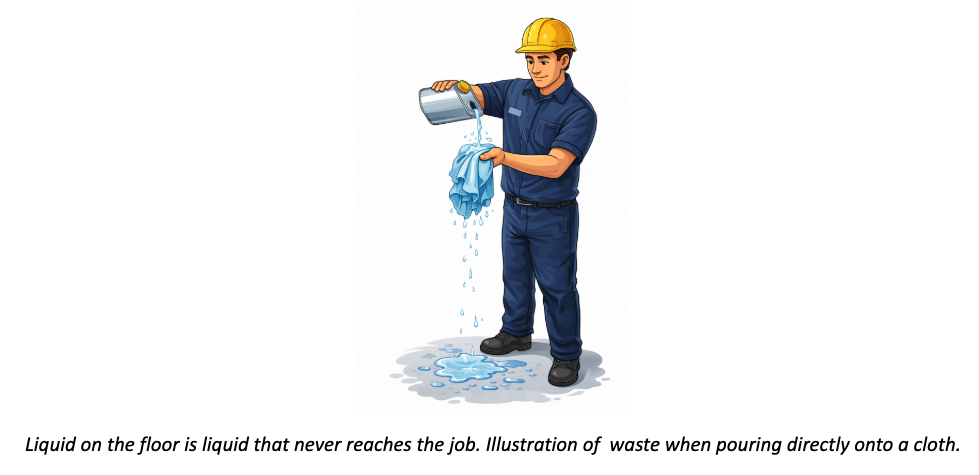
Pouring liquid onto a cloth is a familiar part of many industrial processes. However, the amount applied depends on the operator’s judgement and therefore extremely subjective and potentially inconsistent. A little extra can quickly become more than the cloth needs, with liquid dripping away before it reaches the work surface. Repeating this throughout a shift can turn small losses into significant consumption.
One bottle prepares the whole roll
With our system, the dry roll is supplied in a pouch designed to receive the liquid. The operator adds the complete one-litre bottle and allows the roll to absorb it in accordance with the agreed preparation instructions. The fabric and liquid quantity have already been matched during development, so the operator does not have to decide how much to pour onto each cloth.
That moves dosing into a repeatable preparation step. Each roll starts with the intended quantity of liquid, helping to avoid the repeated over-wetting that can occur when cloths are dosed individually by eye.
What a 50% reduction means
Since introducing this method, we have found that liquid usage in this application has fallen by half compared with the previous pour-on-cloth method. To illustrate the scale of that reduction, the table below applies the same percentage to example consumption figures.
Pouring onto cloths |
Matched roll system |
Liquid saved |
|
2 litres |
1 litre |
1 litre |
|
100 litres |
50 litres |
50 litres |
|
1,000 litres |
500 litres |
500 litres |
Lower liquid consumption also means lower VOC emissions
The liquid used in this case has a high VOC content. Using 50% less of the same formulation means 50% less VOC is introduced into the process. Assuming the same proportion of that VOC evaporates under comparable operating conditions, this translates into a calculated 50% reduction in VOC emissions compared with pouring liquid directly onto cloths.
This gives the reduction in liquid use an additional environmental benefit alongside the saving in liquid purchase costs. The estimated emissions saving is based on the reduction in consumption.
Less liquid used and a more predictable process
At an unchanged price per litre, halving consumption also halves the liquid purchase cost for an equivalent amount of work. That is a saving on the liquid itself; overall process savings will also depend on the cost of wipes, packaging and handling.
The practical benefit goes beyond consumption. A whole-bottle dose removes a measuring step and gives operators a straightforward way to prepare each roll. Less liquid used may also mean fewer liquid containers to handle and discard, depending on the supply format.
This result shows why the relationship between the liquid and the nonwoven matters. The 277-sheet count was chosen for this particular application. Other liquids and tasks may need a different fabric, sheet size or roll configuration.
If your team pours liquid onto cloths, we can help you explore a wipe format designed around your process and assess the savings in your own application.
Contact Speciality Wipes at enquiries@specialitywipes.com.